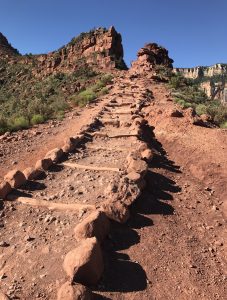
 Kj: I woke up early the morning we stayed at Phantom Ranch. My legs ached in pain with almost a cramping feeling. I took a very soothing hot shower that not only refreshed me but also helped my body loosen up. Soon after, I was dressed and met up with a few of our party that were already awake, ate breakfast, finished packing. We all chatted for a bit and waited until we were ready for the journey to the top. There was a feeling in our group of how are we going to make it out of here. Mentally I was prepared but physically I had my doubts. What struck and shocked me most was when I put my pack on to go, was how much my upper body was hurting. Mentally you know your legs will hurt and be sore. You try to stretch them as best as you can and loosen them up prior to your hike. However, I definitely was not expecting my upper body to be sore and in pain. This was almost defeating because it was so unexpected.
 How can we change this for 2020? I started an upper body routine that concentrates on my glutes, back, shoulders, and arm strength. Deadlifts are excellent for your glutes and back, this will help with both stepping down on your way down and the near vertical trail on the way up. Shoulders and arm strength are both very important especially because of the pack that you are wearing. No doubt, you definitely want to get an excellent backpack for this trip. There are so many different kinds and types that we can discuss on a later post, but something that distributes the weight for sure. Other exercises for shoulders and upper back, include the Farmers Carry which is one of my favorites. This can be done with any heavy objects just about anywhere. Pick them up and walk, you will feel the burn. For arms, I usually stick with the good old curls. You can never go wrong with curls. These are just a few exercises that I am putting in my workout routine to prepare for GC 2020. Most importantly, just don’t forget about your upper body when training because you will need it. Hiking the GC is not just a leg workout, it is a total body workout!
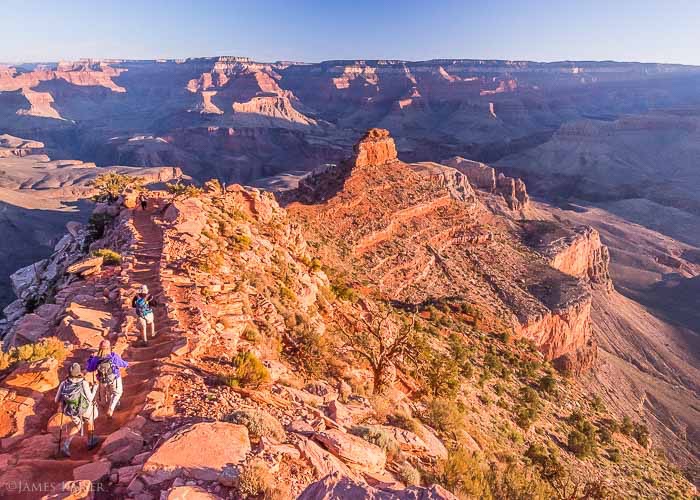
 Pj: I hiked the GC with poles that made a tremendous difference. On the way down, I had increased stability that may have prevented an ankle turn when fatigued. This was demanding on hands, arms, and shoulders as well as small back muscle groups. I used cycling gloves for the hands and paced my self on steep portions. The length and height of the steps on Kiabab S. trail were long and high enough to feel like I had to break stride slow and pivot to reduce over the knee strain going down. Side steps alternating left to right were my consistent go to on the way to Phanton Ranch. After eight plus hours hiking down, I was spent, exhausted, sore, but in one piece for which I was grateful. Upon the recommendation of the National Parks ranger, I soaked in the river near the campground which was soothing, and I’m sure help with the overnight recovery for the hike out.
 The hiking poles were again much needed on the way up. There is soft sand near the river crossing, rocks, and loose gravel on the trail at time and the pole help to test the surfaces as well as distribute weight, increase stability and provide a push when needed.
Prior to a high difficulty hike, practice, practice and practice with the gear you intend to utilize on this challenging hike. You will adapt, increase effectiveness of tool use and learn best practices for a more enjoyable hike. I learned to adjust the height of the poles foe downhill vs uphill that made for less impact on shoulders and improved arm swing.
 Four points of contact are better than two. Test this hypothesis and examine your findings, draw your conclusions! Happy hiking!


 Earlier that day, we walked into the Rotunda of the National Archives with all due reverence and awe to witness our founding documents: The Declaration of Independence, The Constitution and Bill of Right.
 One clear blessing of Liberty is our national parks system and the ability to visit and hike within these national treasures! The national park system has 418 national park sites with 61 of those being distinguished with the “National Park” label in the name, while the others are comprised of national historic sites, national monuments, national seashores, national recreation areas, and others.


 K
K


 Grand Canyon 2020